
FAQ
Rider FAQ
What am I purchasing from OFATV, a membership or a trail access permit?
The OFATV is a membership-based organisation. When you purchase a membership, you have the right to information specific to OFATV members; the right to attend OFATV’s AGM; the right to cast a vote should your club determine you are one of the club’s representatives; and a voice in ATVing in Ontario. (Your membership is the political side)
However… With your membership, you also receive a trail access permit that must be permanently affixed to an ATV. Anyone riding that ATV has access to OFATV trails, provided the permit is valid.
If a person owns more than 1 ATV, will they be required to purchase a second membership to have trail access for both ATVs?
Yes, the trail access permit is available with the purchase of a membership, and because the decal must be permanently affixed to an ATV to be valid, it cannot be transferred from one ATV to another. The decal is designed to go void as soon as it is removed.
If I have purchased multiple memberships does that entitle me to multiple votes?
No. 1 person is only entitled to 1 vote, regardless of the number of memberships that person has purchased
I would like to take a friend or family member out on a ride on OFATV trails, that friend or family member is not a member of the OFATV; do they require a day pass?
- No, provided the ATV that the friend or family member is riding has a valid OFATV trail access permit, a day permit is not required for the friend or family member.
.
If I sell my ATV part way through my membership term, is my trail access permit transferable?
Yes, you may transfer your trail access permit to another ATV you own. If you have NOT put the permit on a machine already, you will need to contact the OFATV office and provide information on the new vehicle. The office will update your permit information, and you can put the permit on your new quad.
If your current permit is already attached to your old machine, replacement permits can be requested through your Member Profile for $12.00 (Tax Included). Select the Permit tab > Replacement Request and then New Request. Fill out the required information and submit; the request will be reviewed by a staff member and approved during regular working hours. You will receive an email indicating the status of your request, and a request for payment. Once complete, you will receive an email with your new temporary permit information and your new permit will be processed and mailed to you shortly. The expiry date of your replacement permit will match that of the original permit. Please be sure to remove the old permit from the machine, as it will now be marked VOID in the OFATV system.
Should you require assistance with the transaction, please email info@quadon.caor call the office at 705-797-0797 during regular business hours.
Do I need to own an ATV to be a member of the OFATV?
Yes, in order to be a member in good standing of the OFATV you must own an ATV. Should you sell your ATV prior to your membership expiring, you will remain as a member until your current membership expires. Some member clubs offer associate club memberships for non-riders. This would allow you to participate at the club level; however, you are not entitled to vote on any OFATV business.
If I sell my ATV partially through my membership period, would I be entitled to a partial refund should I wish to relinquish my membership?
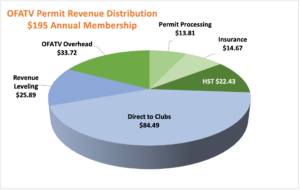
How is my membership fee used?
Refer to Pie Chart
When does my Annual Membership expire?
An annual permit is good for 365 days from the date of purchase – a permit bought on February 8 of one year will expire on February 8 of the following year, for example. If you have NOT selected automatic renewal, you will receive a series of emails before your permit expiry date reminding you that your permit will be expiring shortly. If you have signed up for automatic renewal, you will receive an email informing you that your permit will be renewed on the expiration date. You will have the option to change your information – or even opt out of the process – if desired.
How do I buy an annual membership, 1 day trail permit or 3-day trail permit?
All trail permits are purchased on-line at https://permits2.ofatv.org/, or by selecting Buy a Permit on the OFATV Website ofatv.org
If purchasing an annual permit, it will be effective from the date you purchase it until the same date the following year. You will get an email with your temporary permit information, and your actual sticker will be mailed to the address you provided when setting up your account. You may ride the trails with your emailed temporary permit information right away, until your physical sticker arrives via Canada Post.
If purchasing a 1 day or 3-day permit, be sure to select the start date when entering your information; if you do not select the start date the permit will default to the date of purchase. Temporary permits are emailed as soon as they are completed so you don’t need to wait until you can hit the trails. No physical sticker is sent for a 1 day or 3-day permit purchase.
If you require assistance with the transaction, please email info@quadon.caor call the office at 705-797-0797 during regular business hours.
I don’t have a credit card; how can I purchase a permit without one?
Other forms of payment are accepted but require a little pre-planning. If you prefer to pay by cheque, please mail the cheque to OFATV, PO Box 299, Coe Hill, ON K0L 1P0. The cheque should be made out to the OFATV.
Please include contact information, so the OFATV staff can call you to ensure we have all the required information to process your purchase. E-transfer of funds is also acceptable; please send the e-transfer to info@ofatv.organd contact the office to set up the permit purchase. If selecting e-transfer, you MUST contact the office to complete the transaction.
Does my annual permit automatically renew?
OFATV members have the option to select if they would like automatic renewal, but it is not the default setting. If you have opted to have automatic renewal, you will receive an email 1 month prior to the expiration date of your permit reminding you that your permit will renew in 30 days. You could change any of your information at that time and even cancel the automatic renewal should you wish. If you didn’t select automatic renewal, you will need to manually sign into your account to renew your membership each year.
My annual permit is going to expire soon; how do I renew it?
Visit https://permits2.ofatv.organd sign into your Member Profile and select Permit > Buy a Permit. Under Select Permit Type, choose Renew Annual Permit. This will ensure that your new permit starts upon the expiry of your current permit, and not on the day you are performing the transaction. Previous Permit Number to Renew will appear; the drop-down menu will show you all the current or recently expired permits you have; choose the one you are renewing at this time. Fill out the rest of the required information, submit and pay via Mastercard, Visa, Mastercard Debit or Visa Debit.
If you require assistance with the transaction, please email info@quadon.caor call the office at 705-797-0797 during regular business hours.
My annual permit expired; can I still renew it?
Yes, providing your old permit expired within the last 12 months. Your new permit will start on the current date, not when your old permit expired.
Visit https://permits2.ofatv.organd sign into your Member Profile and select Permit > Buy a Permit. Under Select Permit Type, choose Renew Annual Permit. This will allow the system to auto-fill the information about your vehicle that was previously provided, such as your plate number and Insurance company. A new drop down titled Previous Permit Number to Renew will appear; the drop-down menu will show you all the current or recently expired permits you have; choose the one you are renewing at this time. Fill out the rest of the required information, submit and pay by Mastercard, Visa, Mastercard Debit or Visa Debit.
If you haven’t purchased an annual permit for over 1 year, you will need to select New Annual Permit.
If you require assistance with the transaction, please email info@quadon.caor call the office at 705-797-0797 during regular business hours.
When do the trails open/close for the riding season?
Clubs may each have different landowner and lease requirements. Although there is no absolute rule as to when the trails will open or close (as it is often weather/conditions dependent), many clubs close on December 1st and re-open on May 1st. It is always best to check the QuadON app to see the status of any trail before you ride.
Where else can I ride?
Your valid annual OFATV permit allows you to ride in Nova Scotia, at no additional cost!
How old do I have to be to drive an ATV/UTV on the trails?
You must be 12 years old or older to drive your own ATV on the OFATV trails. Keep in mind that you must have a valid G2 or M2 driver’s license (or greater) to ride on the road, including driving along the side of the road or even just to cross it to get to a trail on the other side.
How old do I have to be to be a passenger?
Although there is no minimum age for passengers on the OFATV trails, the passenger on an ATV must be large enough to wear a properly fitted and secured motorcycle helmet (DOT rated or higher). In a SXS, they must be large enough to be buckled into the seat in addition to wearing a properly fitted and secured motorcycle helmet (DOT rated or higher). Keep in mind, there is legislation covering traveling on, across or along a road. For ATVs on roads, you must have a legally manufactured 2-up ATV, and the passenger must be both 8 years of age AND able to reach the footrest while sitting in the passenger seat. For SXS on roads, the passenger must be a minimum of 8 years old. This is in addition to the same safety requirements as off-road riding (i.e. helmets and seatbelts are required)
Using the QuadON app, you can use the legend to see if your trail is on a legal road by definition.
What do I need to have with me when on the trails?
Be sure to have your driver’s license (if applicable), your vehicle registration papers and proof of insurance. Your machine should have the OFATV permit stuck on the left, front side of the vehicle or – if you are riding with a temporary permit, you should have a copy of the permit available. All riders and passengers must be wearing a properly fitted and secured motorcycle helmet (DOT rated or higher), and if riding a SXS, their seatbelts must be worn.
Can I ride after dark?
Please check with your local club and/or municipality to see what their restrictions are on hours of operation. Likewise, for driving on roads, it is the rider’s responsibility to know the local by-laws they are riding in.
However, please be mindful of reduced vision and ride cautiously to give yourself extra time to react to something that may be on the trail, in addition to being extra courteous regarding engine noise.
Where can I find information about the trails my permit allows me to ride?
Our free app QuadON shows you all the trails covered by an OFATV permit in Ontario; if it’s on the app and open, you are welcome to ride it. The QuadON map may also be viewed at quadon.evtrails.com. Additionally, your OFATV annual permit also allows you to ride in Nova Scotia at no further cost.
Are there additional benefits to being an OFATV member?
Where on my vehicle should I attach my trail permit?
How do I get a replacement permit?
If you require assistance with the transaction, please email info@quadon.ca or call the office at 705-797-0797 during regular business hours.
How do I choose which club to join, and why is this important?
How can I see which club maintains the trails I like to ride the most, so I can join the club that is best for me?
QuadON is the OFATV mapping tool; please go to www.quadon.ca or select Trail Map on the OFATV.ORG home page. Go to the area you are planning on riding in (search bar is in the top right hand corner). Click on any trail in your area: the name of the club who maintains those trails will pop up, along with information about the trail itself.
When I choose a club, can I only use their trails?
No – choosing a club provides you membership to that specific club, but you are welcome to use ALL the trails of ALL the OFATV clubs! Visit quadon.evtrails.com or download the QuadON app to see all OFATV club trails.
How many permits do I need for a multi-passenger vehicle?
Do I need to be named on the permit to ride the machine on the OFATV trails?
My ATV is in the shop and I am borrowing someone else’s ATV; do I need to purchase a permit?
Are there Winter trails?
Several of our clubs have Winter trails available; these clubs are identified on our website OFATV.ORG under the Clubs tab; select Current Clubs. Trail status (open/closed) is viewable on the downloadable QuadON app, or the website quadon.evtrails.com
How do I get a Family Discount?
The OFATV offers a discount to family members residing in the same household wishing to purchase more than two full memberships. The Memberships must all be purchased at the same time. Proof of residency is required for each membership being purchased.
The cost is:
1st Year purchase
Pass 1 & 2: $195.00 each ($172.57 + HST)
Pass 3 and up: $125.00 each (No Limit) ($110.62 + HST).
On Renewal of the Permit
Pass 1 & 2: $175.00 each ($154.87 + HST)
Pass 3 and up: $125.00 each (No Limit) ($110.62 + HST).
When applying, select GO TO FAMILY PASS when asked to choose your Membership Type.
What vehicles can I purchase an OFATV permit for?
The OFATV will accept both type 1 (Built for one person) and type 2 (Built for two people) ATVs as well as UTV (side by side) type vehicles. Please note that some OFATV trails require travel on roads and current laws in Ontario require at least a M2 or G2 drivers license to drive on roads. Please check with your local club before venturing out. Using the downloadable QuadON app or by going to www.QuadON.ca you can use the legend to see if a trail is on a legal road, by definition.
We do not accept 3 wheelers as they do not meet the definition of an ATV or SxS as described in Ontario Regulation 316/03 Part 1.
The OFATV does NOT sell permits for Motorcycles; trail permits for motorcycles are purchased through the Ontario Federation of Trail Riders (OFTR)
Can I purchase a permit for someone else as a gift?
Yes – gift certificates can be purchased for 1 day, 3 day and annual permits. The recipient can choose when to redeem the certificate so, if they already have an annual permit, they can redeem it when their current permit is due to expire. On the OFATV website (ofatv.org) select Buy a Permit. Select the menu option titled Gift Vouchers to make your purchase.
Is there a width limit for my ATV/SxS?
Yes – although the majority of OFATV trails will accommodate 65” wide vehicles there are some exceptions. If you have a machine that is wider than 65”, please contact the club responsible for the area in which you plan to ride to confirm the suitability of their trails for larger machines.
Are ATV/UTV tracks or studded tires permitted on the Winter trails?
Yes; tracks and studded tires are permitted on open trails during the Winter season. However, you should be aware that tracks and studded tires are NOT permitted on roadways, so if you are riding with them across or along a road, you are doing so at your own risk.
Also note that the winter trails are groomed for ATV/UTV usage, and tracks/studs are not required to enjoy the trials.
Can I ride a dirt bike or a jeep or other 4x4 on OFATV Trails?
Some trails within the OFATV system may be multi-use trails, and as such other vehicles may be allowed on them as well. However, the OFATV does not sell permit for any vehicles other than SXS and ATVs.
To learn more about where in Ontario you can enjoy 4×4 trails, go to https://www.of4wd.comand for Dirt Bike trail riding visit https://oftr.ca